I go to nature to be calmed, to be awed, and to be inspired. But I realized this summer as we were taking our granddaughter into nature that it can be such a learning experience as well. Our granddaughter, almost 4 years old when she came to visit for the summer, was already quite precocious. She could recognize all of her letters and write most of them, count to 100 with some help, and recognized some sight words from books she had read over and over again.
This summer I watched as these skills grew by leaps and bounds, without effort, naturally while in nature! She walked through the woods every day and quickly learned to put symbols on our trail map—coyote scat, turkey feathers, and bee trees were added to a basic map (map reading skills). Also, she measured the growth of plants with her whole body as a measuring stick (math skills).
The daily walks led to stories that were told on her return. I would start the story...”Once upon a time, a little girl came to stay with her grandparents for the summer. One day, as she was walking through the woods, she spotted a....” Here I would wait for her to add to the story based on her experience that day. It was a fun reminder of what she had seen but also led to literacy skills. She would then write the story; most of the time this was just a series of circles on the paper because she couldn’t write fast enough to get it all down on paper.
The walks also led to drawings of what she had seen. Sometimes she would look things up in field guides (see the blog post, What's in a Name ). She learned to look in the index to see if the animal was in the guide (reading skills). While drawing insects, she would put 3 legs on one side and 3 on the other. While drawing spiders, she would put 4 legs on one side and 4 on the other. I think it is no coincidence that she quickly learned that 3+3=6 and 4+4=8 (math facts).
Of course, besides reading, writing and math, she was learning science. She was learning to make close observations and comparisons of living things. She was learning about growth and life cycles of plants. Weather patterns, camouflage, growth and life cycles were just a few of the topics in science that she was learning about. All of this in a hands-on concrete approach that ensures not only learning but appreciation of nature.
Since the topic of this blog is learning, I can say that my granddaughter was not the only one learning things this summer. I was learning right along with her, marveling at how much she was absorbing, and enjoying our time together. Never has learning been this much fun!
Thursday, September 10, 2015
Saturday, August 29, 2015
Comfort in Nature
Last week, my husband and I took our camper to Johnson’s Shut In’s State Park in Missouri. The plan was to camp, kayak, and hike while the weather was so beautiful. So, one morning we went to Taum Sauk Mountain State Park to hike the trails. I had never been there before and was looking forward to exploring a new site.
Our hike took us past the highest point in Missouri, along the Ozark Trail to Mine Sauk Falls. The terrain was steep and rocky; the habitat was an extensive woodland-glade complex. Because I had worked almost 10 years in the state, I knew what I was looking at and recognized many species. There were lichen grasshoppers and collared lizards, Goat’s Rue and cup and doily spider webs. As we went along the 3 plus mile trail, I rattled off names of species I recognized.....to the point where my husband said, “Are you making all this up!” No I wasn’t.
But I surprised myself at how much I knew about he habitat and species that lived there. For me, it was a source of a feeling of self-confidence and competence, similar to what I’m sure my granddaughter experienced when she recognized a plant or animal that she encountered while staying with us this summer.
So the idea that this type of knowledge brings a certain comfort level in nature was correct, I thought. That is, until we lost the trail! I am a person who can get lost just turning around, so the fact that we had to roam around looking for the trail frightened me. Suddenly, my comfort level evaporated. Fortunately, my husband is a hunter and used to getting from Point A to Point B without a trail.
After looking at the map and my compass app, we decided on a direction and headed out. I was worried that I didn’t have enough food or water to survive in such a wilderness bushwacking through the brush. So as we set off, I was still worried. Perhaps less that 20 yards away, I found the trail. Whew. Relief. I realize I need to practice off trail hiking in order to gain confidence in that realm. I was glad for the experience, though, and I learned that I am comfortable in nature.....as long as there is a trail leading to the car!!!
Monday, August 24, 2015
What's in a Name
Would a rose by any other name smell as sweet? Perhaps not. But what I have learned from my granddaughter this summer is that names are important.
I used to train teachers in using outdoor activities and realized that some of them feared what might be called “ the unknown”. I used to say, “You don’t need to know the names of the things in nature”. I had learned this tack from a naturalist who used to say that your name isn’t the most important thing about you. While true, names are important. It makes you different than all the other beings that look very similar. The same is true for names of plants and animals. I learned how important this is as I watched my granddaughter gain competence and confidence in being outdoors in nature.
As my husband and I spent time each day outside, we pointed out some obvious species. These would include Red Bud, Hackberry, Mayapple, Black-eyed Susan, 5-lined Skink, Gray Tree Frog, etc. Along with the name, we pointed out some of the key characteristics that would help in identification. In the case of the Red Bud, the heart-shaped leaf is a distinctive trait. These species were pointed out many times until it was our granddaughter pointing them out to us!
It seems the more species she learned, the more comfortable she appeared to be in nature. When I think about it, at first I’m sure our 80 acre wood seemed just like a field of green.... Like a jungle. This could be intimidating to a small child (or my teachers)! But by slowly learning a few of the more common and easily identified species, a level of comfort, and a young naturalist was born. It was part of the summer transformation.
The next step was to use field guides. We often did this when we encountered something that looked distinctive, but we didn’t know what it was. We had a stack of guides specifically written for young people along with adult level field guides. Although she was not yet reading, she could find the pictures of species that resembled something we had seen in nature. From there, we would go to the more specialized guides. Once we found the species and put a name on it, it was more likely to be remembered.
As an example, one day we observed a bee building a nest on our deck roof. We had seen many different types of bees over the summer, but watching this one, looking it up, and attaching a name to it made it a species that she would remember. Days after identifying the species from the field guides, she saw another and said, “Look, there’s a Mason Bee!”. I doubt she would have remembered if we had not taken the time to look it up and find its name.
So here was another lesson I learned from my granddaughter: Learning the names of plants and animals is an important step in competence and confidence building for a young naturalist.
I used to train teachers in using outdoor activities and realized that some of them feared what might be called “ the unknown”. I used to say, “You don’t need to know the names of the things in nature”. I had learned this tack from a naturalist who used to say that your name isn’t the most important thing about you. While true, names are important. It makes you different than all the other beings that look very similar. The same is true for names of plants and animals. I learned how important this is as I watched my granddaughter gain competence and confidence in being outdoors in nature.
As my husband and I spent time each day outside, we pointed out some obvious species. These would include Red Bud, Hackberry, Mayapple, Black-eyed Susan, 5-lined Skink, Gray Tree Frog, etc. Along with the name, we pointed out some of the key characteristics that would help in identification. In the case of the Red Bud, the heart-shaped leaf is a distinctive trait. These species were pointed out many times until it was our granddaughter pointing them out to us!
It seems the more species she learned, the more comfortable she appeared to be in nature. When I think about it, at first I’m sure our 80 acre wood seemed just like a field of green.... Like a jungle. This could be intimidating to a small child (or my teachers)! But by slowly learning a few of the more common and easily identified species, a level of comfort, and a young naturalist was born. It was part of the summer transformation.
The next step was to use field guides. We often did this when we encountered something that looked distinctive, but we didn’t know what it was. We had a stack of guides specifically written for young people along with adult level field guides. Although she was not yet reading, she could find the pictures of species that resembled something we had seen in nature. From there, we would go to the more specialized guides. Once we found the species and put a name on it, it was more likely to be remembered.
As an example, one day we observed a bee building a nest on our deck roof. We had seen many different types of bees over the summer, but watching this one, looking it up, and attaching a name to it made it a species that she would remember. Days after identifying the species from the field guides, she saw another and said, “Look, there’s a Mason Bee!”. I doubt she would have remembered if we had not taken the time to look it up and find its name.
So here was another lesson I learned from my granddaughter: Learning the names of plants and animals is an important step in competence and confidence building for a young naturalist.
Saturday, August 22, 2015
Joy of Discovery
![]() |
| Here she points out a skull on our deer head trail. |
Our routine involved daily walks in the woods. She happily traversed the nearly one mile trail with her grandpa and the two dogs. Along the way, Grandpa would take the time to point out something they had seen the day before or find something new That’s the nice thing about nature....there is always something new. Something to learn. And she was eager to learn.
Whether it was a flower, tree, bug or bird, she would come back to the house after each hike, race to find me, and share with great excitement the things they had discovered along the trail. Part of it was the joy of discovery, but part also was pride in her growing competence. Sometimes when I would walk with her she would point to something and shout, “Look! There’s a......” And it didn’t have to be anything big, like a deer or bear. It could be something as simple as a Black-eyed Susan or Question Mark Moth.
I had read, and realize from my experience with her, that a child will experience the joy of discovery if the adult shares an appreciation of nature with genuine enthusiasm. As Rachel Carson once wrote: “If a child is to keep his inborn sense of wonder, he needs the companionship of at least one adult who can share it, rediscovering with him the joy, excitement, and mystery of the world we live in.” So I realize, this is what we did all summer long.
One time, early in her stay, I saw a Wheel Bug on the screen. When she saw it, she said, “Ugh”....a response probably learned from other kids in her daycare. But in an effort to dismiss this attitude, I looked at it closely and said, “What a neat bug!”. I didn’t know if it would work, but when Grandpa came into the room a little later, she cried, “Grandpa, there’s a neat bug!” She became fascinated with insects and even started her own insect collection. As luck would have it, this year, the 17 year Periodical Cicada emerged, and she became obsessed with pointing out every one she saw. We were constantly stopped on one hike with shouts of “Look!” There were so many cicadas along that trail!.
So the first lesson I learned this summer from my granddaughter: Enthusiasm for nature really is contagious.
Monday, August 17, 2015
Summer Transformation
I have to say, I have not blogged recently for a couple of reasons. One is due to connectivity problems, but mainly it is because of the time spent taking care of my granddaughter while she was here for an extended period of time this summer..
She turned four while here, and I am amazed at how much she has grown and learned since I last blogged about her. My blog about the “bumpy trees” when she was not yet three can be found here. I remember she was almost afraid to touch trees when she was about 2 ½. She was tentative about most things in nature....at first.
So our summer routine involved daily walks in the woods on one of our three trails. This was nearly one mile in length and excellent exercise for her and the two dogs that would end up following her along the way. We camped, kayaked, biked, gardened, explored, watched birds and other wildlife, and much more. Many hours were spent in outdoor pursuits. And the results were amazing.
By the end of the summer, she was romping through the trails, confident and competent. How did all of this happen? I will spend the next few blogs describing our activities and what I learned from her along the way.
She turned four while here, and I am amazed at how much she has grown and learned since I last blogged about her. My blog about the “bumpy trees” when she was not yet three can be found here. I remember she was almost afraid to touch trees when she was about 2 ½. She was tentative about most things in nature....at first.
So our summer routine involved daily walks in the woods on one of our three trails. This was nearly one mile in length and excellent exercise for her and the two dogs that would end up following her along the way. We camped, kayaked, biked, gardened, explored, watched birds and other wildlife, and much more. Many hours were spent in outdoor pursuits. And the results were amazing.
By the end of the summer, she was romping through the trails, confident and competent. How did all of this happen? I will spend the next few blogs describing our activities and what I learned from her along the way.
Monday, November 3, 2014
A Learning Adventure
Recently I attended a regional conference for Project WET, Wild, and Learning Tree facilitators at Beavers Bend State Park in Oklahoma near Broken Bow.
It was a LONG drive from my home but well worth the trip. I have always loved the Projects as an exceptional way to teach environmental topics, but this meeting was about what we, as the facilitators for these national environmental education programs, could learn. I was NOT disappointed.
We stayed in the group camp area in cabins built in the 30's by the CCC. It is phenomenal how much was accomplished for the good of the public during those depression days!
After the first night of meeting new people and becoming familiar with the area, we delved into a learning experience relating to each of the projects the following day. First, related to Project WET, water activities......we sampled for macroinvertebrates at the river to determine water quality..
While I have done this type of sampling many times, the river was beautiful, and so I enjoyed the activity and briefly explored the banks of the river.
This stretch of the river is cold water, due to the hydroelectric dam's release of water, and supports cold water fish like trout. Due to the temperature, waders were used while in the steam. I like doing this activity with kids because they do like to "get their feet wet!"
There were many trout fishermen along this river, so the second activity of the day was appropriate--learning to cast a line for trout. Of course this is something I have never done and I was a little timid to try.
(a wooden stick with string attached) and tried it!
Soon I was ready for the real rod.....
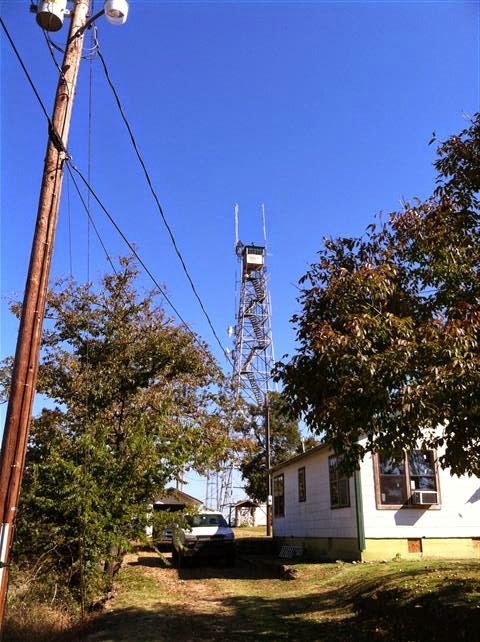
and the line was humming! What a great experience.After lunch we headed for an experience related to Project Learning Tree....forestry activities. For this, we went to a fire tower. We heard about fire contol problems and successes, and met two women who have "manned" the towers for several decades! Then, those who wanted to had the chance to climb the tower....100 feet above ground level.
Few states have operational towers these days, and I believe Oklahoma only has two, but what an experience....what a view! Our guide related many of her experiences in the 4-6 hour shifts in this tiny space. I think I would quickly become claustrophobic or dizzy with the height. What brave souls these people are.
For the final learning experience of the day (related to Project Wild...wildlife), we headed to the 14,000 acre wilderness area that the Red-Cockaded Woodpecker calls home. This endangered bird requires a specialized habitat of Short-Leaf Pine and Bluestem.
The wilderness we visited was virgin forest; the woodpecker requires large (old) pines for nesting. The wildlife biologist that met us on the property impressed us with his enthusiasm and hard work to monitor and manage habitat for this species. He also noted that the management was beneficial for many other species including deer, turkey and quail.
The arduous task of climbing over 45 feet in the large pines was demonstrated, much to our awe!
All too soon, we headed out of the wilderness, toward civilization and the pizza place for dinner. It had truly been a wonderful day, learning through a variety of experiences. I wish all learning could be this way. Certainly it was a trip I won't soon forget!
Tuesday, October 21, 2014
Which is Your Favorite Season?
I have been away from this blog and my home for the last couple of weeks exploring our national parks in Utah. (more about that on a later blog post)
When I returned, I was amazed to see the change in our woods. Fall is here!!
This photo is from our trip; it seems that fall is everywhere. This got me thinking about the changing seasons and which season I preferred.
Fall has always been a favorite of mine. It was always a time of change in my life--the school year started-- and big changes to observe in nature. The fall color transforms the natural world into a sensory treat. Although many painters try to capture the fall colors, nature's palette is so superior. Photos can't capture the beauty either, so it is best to stop and enjoy the view.
Winter has always been a hated time of year for me due to the cold and dark days that come with this season. Add in a snow storm, and I hunker down inside. However, last winter I found joy in following animal tracks after a new fallen snow or in hearing the owls hooting. Even the trees that were once adorned with colorful leaves seem beautiful as their branches are now exposed. Now that I can avoid the hassle of "getting to work" on icy streets, I know I will gain a new appreciation of this season.
Spring has never been on my radar. This is probably because it is such a busy time of year. The season's beauty has escaped me in the past, but this year I hope to focus on those early harbingers of spring....migratory birds. Last year I watched as geese flew north; this year I hope to focus on those that come from the south to spend summer here in the Midwest. The spring woodland wildflowers are also a welcome site of spring. When the Dutchman's Breeches, Mayapples, Spring Beauties, and others appear on the forest floor, I know nature is waking up....I just need to pay attention to it.
Finally, there is summer. Although I love the warmth of the sunshine and the long daylight hours, it has never been my favorite season. I'm not sure why.
Last summer I rediscovered the joys of gardening and hope to expand this year, planting enough for me and the turtles!
Watching the bats flying erratically overhead and listening to the croaking of the frogs provide great summer entertainment. I can't wait for the "reruns" this summer.
Bottom line: I think there are things to enjoy about all of the seasons. This year, as I begin a new season in my life--retirement--, I hope to embrace them all more fully.
What will you find to enjoy as the seasons change?
When I returned, I was amazed to see the change in our woods. Fall is here!!
This photo is from our trip; it seems that fall is everywhere. This got me thinking about the changing seasons and which season I preferred.
Fall has always been a favorite of mine. It was always a time of change in my life--the school year started-- and big changes to observe in nature. The fall color transforms the natural world into a sensory treat. Although many painters try to capture the fall colors, nature's palette is so superior. Photos can't capture the beauty either, so it is best to stop and enjoy the view.
Winter has always been a hated time of year for me due to the cold and dark days that come with this season. Add in a snow storm, and I hunker down inside. However, last winter I found joy in following animal tracks after a new fallen snow or in hearing the owls hooting. Even the trees that were once adorned with colorful leaves seem beautiful as their branches are now exposed. Now that I can avoid the hassle of "getting to work" on icy streets, I know I will gain a new appreciation of this season.
Spring has never been on my radar. This is probably because it is such a busy time of year. The season's beauty has escaped me in the past, but this year I hope to focus on those early harbingers of spring....migratory birds. Last year I watched as geese flew north; this year I hope to focus on those that come from the south to spend summer here in the Midwest. The spring woodland wildflowers are also a welcome site of spring. When the Dutchman's Breeches, Mayapples, Spring Beauties, and others appear on the forest floor, I know nature is waking up....I just need to pay attention to it.
Finally, there is summer. Although I love the warmth of the sunshine and the long daylight hours, it has never been my favorite season. I'm not sure why.
Watching the bats flying erratically overhead and listening to the croaking of the frogs provide great summer entertainment. I can't wait for the "reruns" this summer.
Bottom line: I think there are things to enjoy about all of the seasons. This year, as I begin a new season in my life--retirement--, I hope to embrace them all more fully.
What will you find to enjoy as the seasons change?
Subscribe to:
Posts (Atom)


.jpg)