The last stop on my quest to find nature while on my European vacation was Germany. Here we would spend time in a small village and in Berlin.
Upon landing in Berlin and heading to the countryside, it already seemed promising that I would find nature here. We drove past wooded areas and pastures that reminded me of home. Our hosts had a plot in a community garden which was well manicured, and many of the villagers had yards with ponds and various ornamental plantings. Here I heard frogs and saw them hop into the ponds before I could identify them. They sounded similar to the green frogs at home. And I heard several birds calling, but certainly not nearly as many as I can hear from my deck at home.
One day we accompanied our host to a local school. I was impressed with
the grounds of the school (very green) and the large bank of windows in
each classroom. After teaching without any windows for much of my
career, I appreciated the calming effect the view of green has on
students.
What impressed me most in Germany was the transportation
system....rail lines serve the small towns and bring some of the
students to school. There is also a "fast train" to Berlin, which we
took.
In the cities of Europe, there was a large presence of bicyclists
commuting to work. Here is a bike rack in Berlin.
Energy sources seem to be diversified as evidenced by the fields of
solar collectors and wind turbines we passed along the highway. Many
buildings had solar collectors also.
We stayed in an eco friendly hotel in Berlin. Its mission was to create a peaceful environment; one way it did that was to make the elevators seem like you were in a forest, complete with bird sounds. That really was relaxing.
All in all, I was impressed with conservation efforts in Germany. These are probably in place out of necessity....when you have little in the way of resources, it is wise to conserve. But still I was not impressed with the biodiversity when compared to the US.
I looked for controversial issues in conservation (and I am aware that solar and wind power both have detractors) but found little to report as environmental issues.
The biggest controversy: who would win the World Cup game between Germany and USA.
We were interviewed by a TV news crew in front of the US Embassy in
Berlin the day before the match. Being on TV in Germany was something
we never imagined would happen, but when you
travel, you have to expect
anything!
We had been to many places and had many great experiences, but after nearly a month abroad I was anxious to come back home where the search for nature would not be so difficult.
As our journey wrapped up, I realized how fortunate we are to live in the USA. There are many things to be thankful for in this country, not the least of which is our abundant natural resources. So as the custom agent said to me, "Welcome home", I replied, "It's good to be back." And it is.
Monday, August 25, 2014
Wednesday, August 20, 2014
Is there nature in Paris?
That was the question during my European vacation. Where would I find nature? I wasn't expecting much in Paris; after all, it is a huge city with 83 million visitors annually. And I wasn't disappointed.
The view was spectacular...and I viewed the city from the Arc de Triomphe, Notre Dame, and the Eiffel Tower (shown here). You could see some parks and tree-lined streets, but when you saw these at street level, they were highly manicured. Even the trees were pruned to create an effect.
Of course, a city this size had the usual "wildlife". A pigeon in the park----or should I say, many. And most disgusting was the rat I saw near the Louvre.
But inside the Louvre and other museums, I finally found nature:
This looked like the Coca-Cola bear!
I most enjoyed the mythical creatures on Notre Dame:
My goal was also to become aware of environmental issues in each place I visited. Besides the rat issue--apparently some don't want them killed---I was aware of the lock issue. Many tourists have bought or brought locks, attached them to these old city bridges and thrown the key in the river. There is some romantic notion behind this, but I was only aware of the pollution to the river and the damage to these bridges. Apparently the government spends lots of money taking them off to ensure the integrity of the bridge.
The cost is borne by the taxpayers of the city. As I was explaining the problem to a visitor, this rationale did not seem to quell the romantic drive to place a lock on the bridge. Later, though, I learned of the visitor's change of heart when a facebook friend had said a fine of $300 could be imposed on the visitor. With this I learned a valuable lesson in human behavior and environmental change. If costs are shared, it does not deter negative behavior, but if a cost is borne by the individual, behavior does change. Interesting.
So much for my adventures in Paris. Next we would go to Germany.
Monday, August 18, 2014
A National Park in a Different Nation
This blog is a continuation of my report on looking for nature during my summer vacation in Europe. Up to this point in my travels, I had seen little of nature compared to the US. I was most excited to schedule a trip to Italy's National Park...Cinque Terre.
Surely, if nature were to be found, it would be here! This park is along the rocky coastline in northern Italy and had become a national park only in 1996. A baby compared to the National Parks, like Yellowstone, that I have visited in the US.
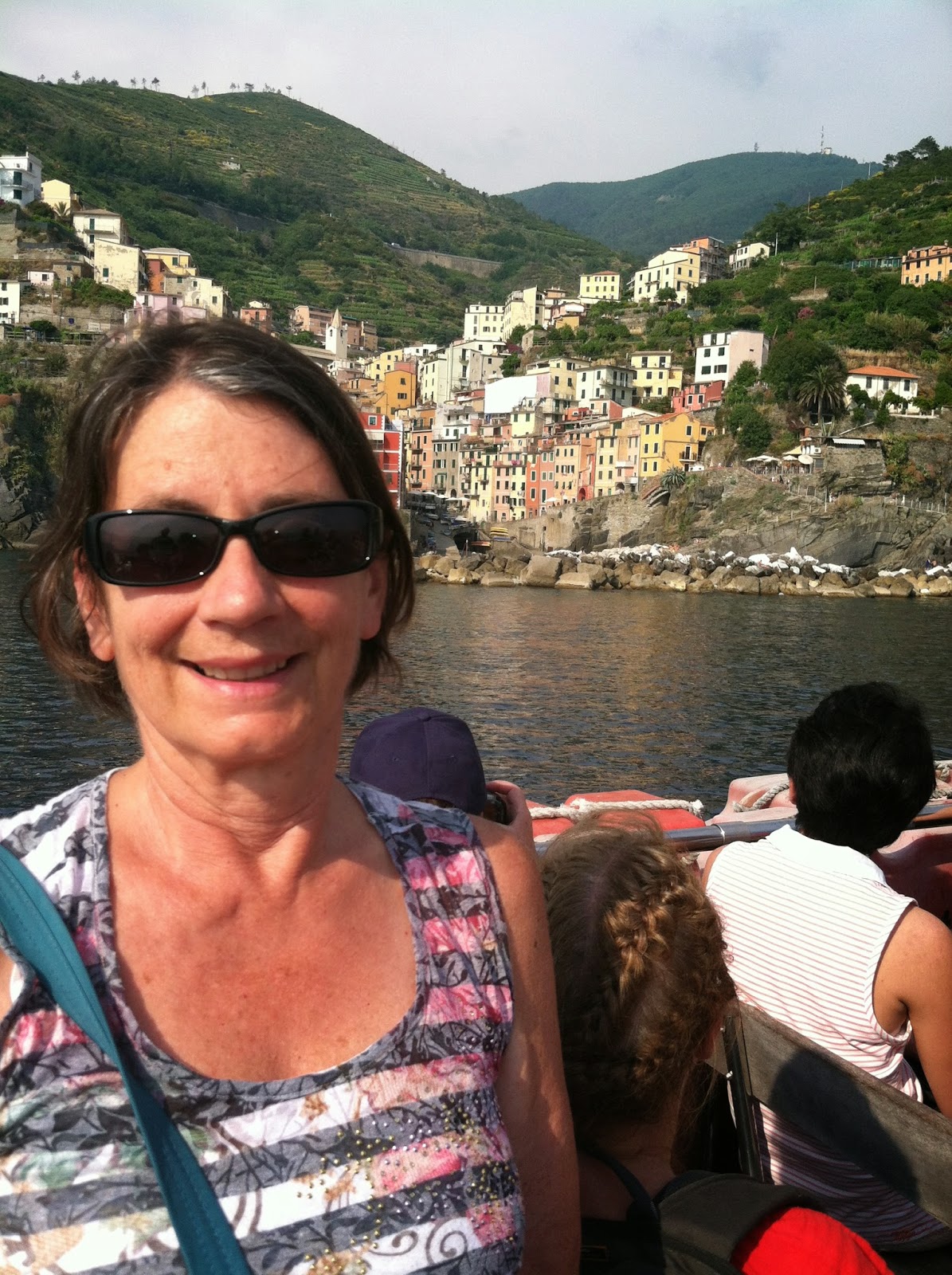
On our bus tour to the park, we learned of the love-hate relationship between tourists and residents in the 5 small villages that are found within park. This designation has been a boon to the economy but has also brought changes that are negatively viewed by some of the older residents.
The quaint, picturesque villages nestled on the steep slopes of the Mediterranean face harsh winter weather conditions as well. We saw houses that had large rocks on the roofs to hold them down during windy times. They can survive the winters, but will the villagers survive the deluge of tourists?
Another controversial issue we learned of involved the Apuan Alps marble quarrys we passed on the way to the coast. This area, while being used as a quarry since the second century BC, is being threatened by the sheer number of quarrys (300) that take 1.5 million tons of marble and 2 million tons of crushed stone each year. This creates a threat to the picturesque beauty of the region along with ground water pollution and heavy traffic issues. These mountains are where Michelangelo chose the marble for his sculptures, so there is historical significance to this area as well.
Back to my quest to see nature: I hiked some of the trail that connects the five quaint villages. The trails are steep; the drop off into the Mediterranean quite dramatic.
You can see the rugged countryside with scrubby looking plants. We walked through olive groves, saw yucca--the symbol of the park--and those wonderful yellow flowers (see previous post).
Besides the scenic beauty and rugged slopes with hardy plants, I saw little in the way of "wildlife". But it was a hot day, even by Italian standards. And perhaps I was so taken with the scenery that I missed some opportunities to see wildlife.
A highlight of the trip was soaking my tired, hot feet in the Mediterranean.
My quest to find nature would have to continue on my next stop...Paris.
Surely, if nature were to be found, it would be here! This park is along the rocky coastline in northern Italy and had become a national park only in 1996. A baby compared to the National Parks, like Yellowstone, that I have visited in the US.
On our bus tour to the park, we learned of the love-hate relationship between tourists and residents in the 5 small villages that are found within park. This designation has been a boon to the economy but has also brought changes that are negatively viewed by some of the older residents.
The quaint, picturesque villages nestled on the steep slopes of the Mediterranean face harsh winter weather conditions as well. We saw houses that had large rocks on the roofs to hold them down during windy times. They can survive the winters, but will the villagers survive the deluge of tourists?
Another controversial issue we learned of involved the Apuan Alps marble quarrys we passed on the way to the coast. This area, while being used as a quarry since the second century BC, is being threatened by the sheer number of quarrys (300) that take 1.5 million tons of marble and 2 million tons of crushed stone each year. This creates a threat to the picturesque beauty of the region along with ground water pollution and heavy traffic issues. These mountains are where Michelangelo chose the marble for his sculptures, so there is historical significance to this area as well.
Back to my quest to see nature: I hiked some of the trail that connects the five quaint villages. The trails are steep; the drop off into the Mediterranean quite dramatic.
You can see the rugged countryside with scrubby looking plants. We walked through olive groves, saw yucca--the symbol of the park--and those wonderful yellow flowers (see previous post).
Besides the scenic beauty and rugged slopes with hardy plants, I saw little in the way of "wildlife". But it was a hot day, even by Italian standards. And perhaps I was so taken with the scenery that I missed some opportunities to see wildlife.
A highlight of the trip was soaking my tired, hot feet in the Mediterranean.
My quest to find nature would have to continue on my next stop...Paris.
Friday, August 15, 2014
Seeing Nature in Europe
I have been away from this blog all summer--my how time flies! Now is time to write about "What I did on my summer vacation"---remember all those grade school prompts! I spent much of June in Europe with three traveling companions. It was a marvelous, once-in-a-lifetime trip. During the adventure, my goal was to find nature and find out about conservation issues in other countries. The problem is, there was so much to see and do, and so little nature in my estimation, that I often forgot that goal until reminded by the companions. So what follows (and the next couple of blogs) is what I observed on my summer vacation.
We flew into Rome on an overnight flight (I didn't sleep), checked into the hotel and lined up for our first tour of the Colosseum and Roman ruins. I know I was bleary-eyed but saw little to speak of at first.
Then we went to Palatine Hill, the birthplace of Rome, and immediately I noticed this tree. Its familiar leaf shape and sheen was apparent to me. An olive tree! I am familiar with the autumn olive that is the invasive species in the midwest, and this tree was so similar. We would see many groves of olive trees and vineyards in the landscape of Rome and Tuscany.
As it so happens, we stayed in a B and B overlooking the countryside. Across the road was a grove of olive trees and I noticed the farmer cultivating these fields like mid western farmers would for a corn field. As I walked through the grove, I saw many beautiful flowers....some resembled the roadside plants (wild carrot and chickory) in the U.S., but I don't know what any of them were.
Notice the bright blue sky. It was rather warm in Italy, much like home. This leguminous plant was growing wild everywhere. If you know what it is, let me know.
And I like the way the sun is shining on this purple flower.
Also in the grove were insects and spiders. I soon spied this web. The bowl and doily web contained a small spider which I could not identify. I did not take field guides on the trip because I packed so light--just a small backpack.
From our B and B I heard a few birds, not many, and this was surprising to me. We were a couple of miles from a small medieval village, and there were plants all around. Where were the birds and other animals? I heard the collared dove, which is an invasive in the U.S. and probably in Italy as well. It's loud coo tends to cover up any other birds.
We saw pigeons in the village....many of them, around a polluted fountain.
And I finally was able to photograph a lizard. I had seen many, but they scurried too fast. This one had lost part of its tail, perhaps slowing it down..
In general I had been disappointed in the amount of wildlife I could easily observe, but it made me appreciate what we have back home.
Soon, we would go to Cinque Terra....the National Park in Italy. Maybe that would lead to more animal sightings!
We flew into Rome on an overnight flight (I didn't sleep), checked into the hotel and lined up for our first tour of the Colosseum and Roman ruins. I know I was bleary-eyed but saw little to speak of at first.
Then we went to Palatine Hill, the birthplace of Rome, and immediately I noticed this tree. Its familiar leaf shape and sheen was apparent to me. An olive tree! I am familiar with the autumn olive that is the invasive species in the midwest, and this tree was so similar. We would see many groves of olive trees and vineyards in the landscape of Rome and Tuscany.
As it so happens, we stayed in a B and B overlooking the countryside. Across the road was a grove of olive trees and I noticed the farmer cultivating these fields like mid western farmers would for a corn field. As I walked through the grove, I saw many beautiful flowers....some resembled the roadside plants (wild carrot and chickory) in the U.S., but I don't know what any of them were.
Notice the bright blue sky. It was rather warm in Italy, much like home. This leguminous plant was growing wild everywhere. If you know what it is, let me know.
And I like the way the sun is shining on this purple flower.
Also in the grove were insects and spiders. I soon spied this web. The bowl and doily web contained a small spider which I could not identify. I did not take field guides on the trip because I packed so light--just a small backpack.
From our B and B I heard a few birds, not many, and this was surprising to me. We were a couple of miles from a small medieval village, and there were plants all around. Where were the birds and other animals? I heard the collared dove, which is an invasive in the U.S. and probably in Italy as well. It's loud coo tends to cover up any other birds.
We saw pigeons in the village....many of them, around a polluted fountain.
And I finally was able to photograph a lizard. I had seen many, but they scurried too fast. This one had lost part of its tail, perhaps slowing it down..
In general I had been disappointed in the amount of wildlife I could easily observe, but it made me appreciate what we have back home.
Soon, we would go to Cinque Terra....the National Park in Italy. Maybe that would lead to more animal sightings!
Monday, May 26, 2014
Are Parks for the People?
I have been reading Edward Abbey's Desert Solitaire in preparation for a trip to Utah's National Parks. As I think about getting our pop-up ready for the summer season, I think about what he had to say about crowded parks being like little cities.
That is exactly the same thought I had as we camped last year in a state park near Atlanta. At first I was happy to see all the families out in nature...until I looked closely at what they were doing and saying. Kids riding bikes. Light shows around trailers. Loud talking around the campfires. Adults were talking about what camping supplies they had and where to get them. Kids were talking about playing games and what type of dog they had. Dog walkers set off a round of early morning barking by every canine in the park.
What is interesting is how the park cleared out after the weekend and nature returned: the chickadee was chirping, the frog calling. Gone were the sounds of speedboats and trucks along the campground roads. Now the crows claimed their supremacy over the morsels left behind. Finally, this was a place of peace and solitude, a place to appreciate nature. But what about those others who had left? What is green space when it is packed with people? Where is the communion with nature when overpowered by the presence of too many people?
I am reminded of a quote from Aldo Leopold's foreword to Sand County Almanac: "There are some who can live without wild things, and some who cannot." Count me among those who cannot! My concern is that I will not be able to find the wild...to find the solitude I seek. Certainly, I will not be camping this weekend, Memorial Day. I know better than to do that.
I wish there were places for people like me. Abbey referred to this problem in his book. When Desert Solitaire was published in 1968, the National Park Service slogan was "Parks are for people." But Abbey alerted readers to the problems of development of these last great wilderness areas. While the developments allowed more people in to the parks, he suggested that you can bring people to nature, but you can't make them appreciate it. That is exactly the experience I had near Atlanta. And in fact, the sheer numbers of people can impact the appreciation and enjoyment of nature.
If parks are for people, what about people like me? Where is my park? During this summer season, I will probably have to stay home. My park is the one after everyone has left for the season or gone back to work after the weekend. My park is getting harder and harder to find.
That is exactly the same thought I had as we camped last year in a state park near Atlanta. At first I was happy to see all the families out in nature...until I looked closely at what they were doing and saying. Kids riding bikes. Light shows around trailers. Loud talking around the campfires. Adults were talking about what camping supplies they had and where to get them. Kids were talking about playing games and what type of dog they had. Dog walkers set off a round of early morning barking by every canine in the park.
What is interesting is how the park cleared out after the weekend and nature returned: the chickadee was chirping, the frog calling. Gone were the sounds of speedboats and trucks along the campground roads. Now the crows claimed their supremacy over the morsels left behind. Finally, this was a place of peace and solitude, a place to appreciate nature. But what about those others who had left? What is green space when it is packed with people? Where is the communion with nature when overpowered by the presence of too many people?
I am reminded of a quote from Aldo Leopold's foreword to Sand County Almanac: "There are some who can live without wild things, and some who cannot." Count me among those who cannot! My concern is that I will not be able to find the wild...to find the solitude I seek. Certainly, I will not be camping this weekend, Memorial Day. I know better than to do that.
I wish there were places for people like me. Abbey referred to this problem in his book. When Desert Solitaire was published in 1968, the National Park Service slogan was "Parks are for people." But Abbey alerted readers to the problems of development of these last great wilderness areas. While the developments allowed more people in to the parks, he suggested that you can bring people to nature, but you can't make them appreciate it. That is exactly the experience I had near Atlanta. And in fact, the sheer numbers of people can impact the appreciation and enjoyment of nature.
If parks are for people, what about people like me? Where is my park? During this summer season, I will probably have to stay home. My park is the one after everyone has left for the season or gone back to work after the weekend. My park is getting harder and harder to find.
Thursday, May 22, 2014
Three Generations of Bug Lovers
On my granddaughter's third birthday, I decided to expand her nature study beyond birds. It was time to explore the world of insects. So, I sent off a package of tools for insect study: a field guide, magnifier, and collection jar. Simple. Later in the evening, my daughter sent me a photo of what they found:
Even though I could not be there, I can imagine the squeals of joy as she found this praying mantis....right in her backyard.
That got me to thinking about the many times my husband and I would point out insects to our kids. The insect world is so diverse and fascinating. AND abundant in our big backyard in the country. We saw ant lions, wheel bugs, velvet ants, and many more.
And this fascination with the insects can be traced back another generation...to my own childhood. Even though I grew up in a city, I remember catching fireflies on a summer's evening. Great fun.
I can't wait to go bug hunting with my granddaughter on her next visit to the country.
Even though I could not be there, I can imagine the squeals of joy as she found this praying mantis....right in her backyard.
That got me to thinking about the many times my husband and I would point out insects to our kids. The insect world is so diverse and fascinating. AND abundant in our big backyard in the country. We saw ant lions, wheel bugs, velvet ants, and many more.
And this fascination with the insects can be traced back another generation...to my own childhood. Even though I grew up in a city, I remember catching fireflies on a summer's evening. Great fun.
I can't wait to go bug hunting with my granddaughter on her next visit to the country.
Sunday, May 11, 2014
Nature Lover Revisited
Previously in this blog I wrote a post called "Tribute to a Nature Lover", dedicated to my mom. The words I wrote then are no less true today, Mother's Day. While my mom is not with me this Mother's Day, she fills my thoughts. So I created a Wordle from that blog. This reveals the one constant for me in the memory of my mom--her love of nature and family.
Subscribe to:
Posts (Atom)
.jpg)
.jpg)